
Last
Delivery.
Wrong package. Wrong person.
Very bad day.
A routine drop-off.
An impossible shift.
A routine drop-off turns into the worst shift of one delivery driver's life. Somewhere between stop twelve and stop thirteen, the wrong box ends up in the wrong hands — and now half the city wants it back. LAST DELIVERY is a high-speed action-comedy built around the most unlikely hero possible: someone who never signed up to be one. No training. No plan. No idea what's actually in the box. Just a uniform, a beat-up delivery vehicle, and a deadline that refuses to care about armed strangers, wrecked cars, or citywide chaos. It's an ordinary job turned into an extraordinary problem — and a reluctant underdog just trying to clock out alive.
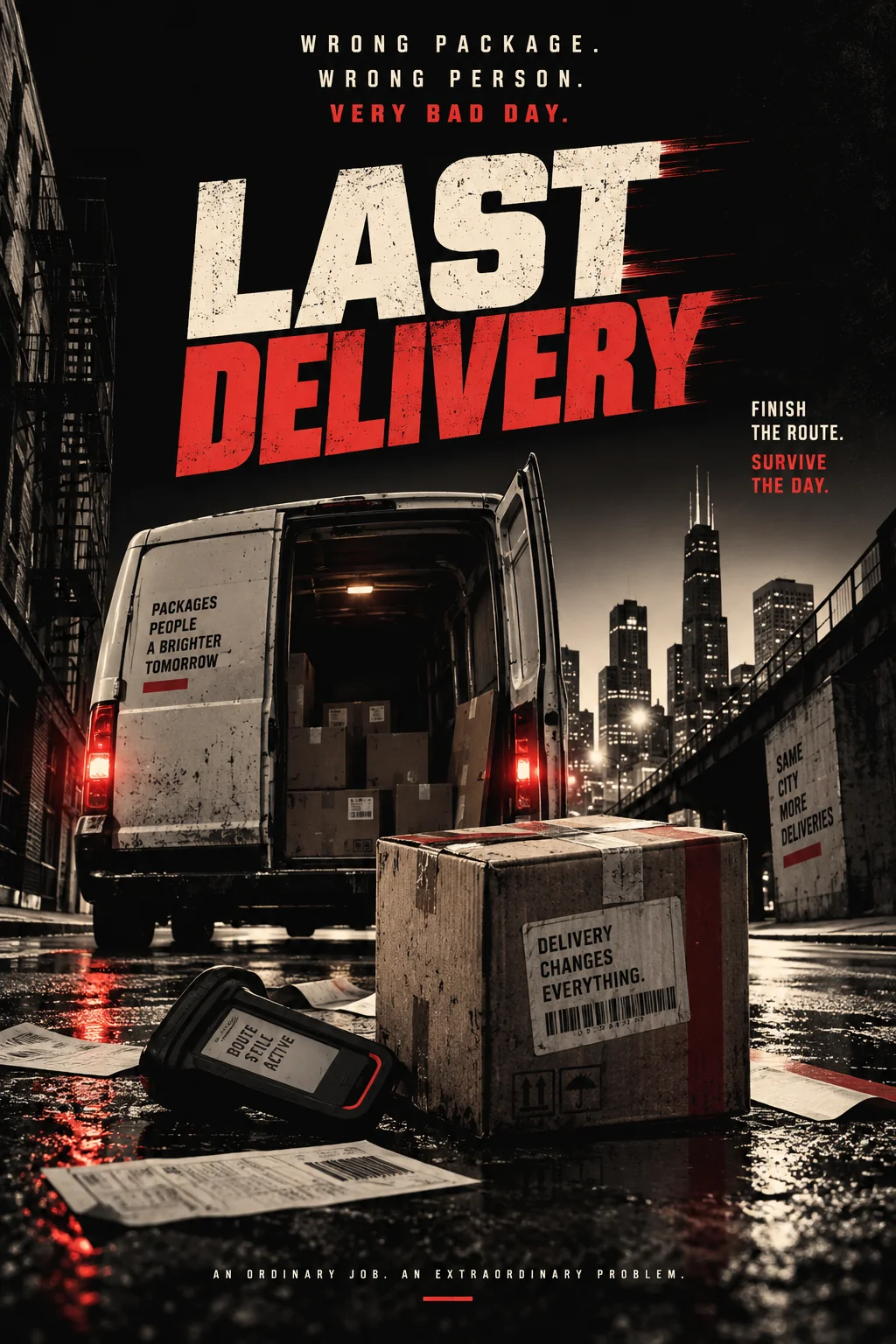
Finish the route.
Survive the day.
A normal shift should end with a paycheck.
Not a car chase.
Not armed strangers.
Definitely not half the city suddenly convinced that the box sitting in the back of a delivery vehicle belongs to them.
LAST DELIVERY starts small — a scanned label, a wrong address, a package that looks like every other package. Then the knock on the door isn't a customer. It's a problem. And the problem doesn't go away when the shift ends. It just multiplies.
By the time the driver realizes what's actually happening, there's no clean way out. Just a city full of people who want what's in that box, a vehicle that was never built for this, and a very simple, very stubborn goal: finish the route. Survive the day. Go home.
A chase movie.
A workplace comedy.
At its center, LAST DELIVERY is a chase movie disguised as a workplace comedy — or a workplace comedy disguised as a chase movie, depending on which scene you're watching.
The premise runs on a simple engine: an ordinary person, doing an ordinary job, gets pulled into a situation built for someone else entirely. Not a spy. Not a soldier. Not a criminal with a plan. A delivery driver whose entire skill set is reading addresses, avoiding potholes, and not getting yelled at by customers.
That mismatch — ordinary person, extraordinary danger — is where the comedy and the action both live. Every escape is improvised. Every close call happens because of instinct, not training. The driver isn't clever because the script needs them to be clever. They're clever the way anyone is clever when their life depends on it — messily, desperately, and occasionally by accident.
The city becomes
a character.
The city itself becomes a character.
Every block is a new obstacle. Every shortcut is a gamble. Loading docks, back alleys, traffic-choked intersections, rooftop parking structures — the everyday geography of a delivery route gets reimagined as a playground for pursuit, near-misses, and escalating stakes.
And the package's pursuers aren't a single, tidy threat. LAST DELIVERY creates room for multiple factions with competing interests in the box — each one showing up at the worst possible moment, each one assuming the driver knows more than they actually do. That collision of interests is what keeps the chase alive: it's never just one group hunting one target. It's a citywide scramble, and the driver is standing in the middle of it, holding a clipboard.
Just trying to
survive a Tuesday.
The driver isn't a hero. That's the point.
They're underqualified, underpaid, and completely uninterested in whatever's happening. There's no secret backstory waiting to be revealed, no hidden combat training. What they have instead is stubbornness — a refusal to let one impossible day become the reason they lose their job, their car, or their nerve.
That stubbornness is the emotional core of the project. Somewhere between the first threat and the last, "just get through the shift" stops being about a paycheck and starts being about proving they can handle whatever gets thrown at them — literally.
The driver's ordinariness is the joke and the heart of the story at the same time. They're not trying to save the city. They're trying to survive a Tuesday.
Every stop.
A new complication.
What keeps LAST DELIVERY moving is momentum — the package has to keep moving, the danger has to keep escalating, and the driver has to keep improvising.
Structurally, this premise is built for episodic expansion as easily as it works as a film. Each new stop on the route can introduce a new complication, a new faction, a new reason the day refuses to end. The "wrong package" concept can generate an entire season of near-misses before the driver ever gets a clean answer to the question everyone keeps asking: what's actually in the box?
Real danger.
Real absurdity.
Wrong-place-wrong-time action × workplace comedy × relentless bad-day energy.
This is not a prestige thriller. It's not meant to be grim. The tone lives in the gap between real danger and real absurdity — high-stakes chases undercut by the fact that the person driving has absolutely no business being in one.
Action should move fast and feel kinetic. Comedy should come from competence gaps, mistaken identity, and the sheer indignity of being chased for something you didn't ask for. The humor and the tension aren't competing — they're the same joke, told at different speeds.
A bad day
that keeps escalating.
Everybody has had a bad day at work. LAST DELIVERY just asks: what if the bad day never stopped escalating?
The premise is instantly understandable — wrong package, wrong person, chaos — and endlessly flexible. It doesn't require an elaborate mythology or years of setup to make sense. One scanned label. One knock at the wrong door. That's the whole pitch, and it's enough to build a chase, a comedy, and a character all at once.
Build the chase.
LAST DELIVERY creates natural creative openings across multiple disciplines:
Action design
car chases, foot chases, close-quarters improvised escapes
Comedy writing
mistaken identity, escalating misunderstandings, deadpan reactions to chaos
Character design
the driver's uniform, vehicle, and everyday gear becoming visually iconic through repetition and wear
Vehicle and prop design
the delivery vehicle itself as a recurring visual signature
Poster and key art
high-contrast, motion-driven imagery built around the box, the uniform, and the city
Music
a soundtrack that can lean into propulsive, chase-driven energy, with room for an ironic, laid-back theme underscoring just how unqualified the driver is for any of this
Episode or sequence concepts
each new stop on the route functioning as its own contained set piece
New routes.
New possibilities.
The wrong-package premise has natural room to grow. Future stories could follow different drivers, different routes, or different cities — same chaotic mechanic, new set of circumstances. The mystery of what's actually inside these kinds of packages could open the door to a recurring world of couriers who keep ending up in the wrong place at the wrong time. None of this is confirmed — but the premise creates the space for it, if the world is worth returning to.
One wrong package.
One creative universe.
LAST DELIVERY is a small idea with a big engine — proof that the most relatable premise in the world (a bad shift at work) can become a full-speed collision of action, comedy, and character. It's the kind of concept YOUNIVERSOUL MUSIC ENT. exists to find: not because it arrived polished, but because the world inside it was already moving.
One wrong package. One unqualified hero. One city that won't let them clock out.
ONE CREATIVE UNIVERSE. MULTIPLE WORLDS. YOUNIVERSOUL MUSIC ENT.